People who don't know things refer to those who told them about what goes on view them as hero's. This is true under what went on with the NSA leaked information by Edward Snowden. Ever since his video where he tells what he discovered, people have been demoralizing the current government and praising Edward Snowden. Be it may what he found out can be considered important to some, in reality it isn't important at all. In fact, this has already been known since 2006. All he did was break the law.
Be it may on how you feel what the NSA is doing is "right" or "moral", it is legal under the 4th amendment, all 3 branches of government, and even the Patriot Act if you want to go in that deep. But what they have been doing in terms of keeping phone records, has been going on since 2006. Think about it, this has all been public knowledge for 7 years, and only know is he making a big deal out of it.
Snowden himself has done nothing to be worthy of being called a "hero". He has had this position in which to find out all the information he wanted about any sort of program. Instead, he sat nicely in Hawaii with his girlfirend and a nice-paying job. Also, instead of staying in America and defending what he did to the fullest extent of the law, he rant to Hong Kong. While this isn't cowardly, its not right with his own character. Laws exist for a reason, and when you break those laws, you should be tried before a court of his own peers to decide. Want an example of this in context to what Snowden did?
Back in the early 1970s Daniel Ellsberg leaked out information on how Congress and the administrations such as Lyndon B. Johnson have been publicly lying about what has been happening in Vietnam. This caused uproar and Ellsberg was put on trial. Here Ellsberg didn't run away he stood by and said that what he did was right
"I felt that as an American citizen, as a responsible citizen, I could no
longer cooperate in concealing this information from the American
public. I did this clearly at my own jeopardy and I am prepared to
answer to all the consequences of this decision."
What resulted from his trial was all of the charges put off and he was free. Say whether what Ellsberg did was right or wrong, but he felt that he was justified in his actions and stood by. Snowden isn't the same because he ran away. He also has information against him because he has known this has been going on all these years, and only until now decided to change something. The way to fight the law isn't to break it, that makes you as bad as those who you are fighting. The way to fight it is to petition, demand change, elect other officials, there are several ways. The people have a right to know why he did it and what else of our national security he's willing to sell. Him breaking a security clearance to the country and exposing possible things that could jeopardize the security of the country is treason, and he should want his day in court to prove his point.
Things have changed from 03 - 13. The Patriot Act is still around, but it has been changed. Haebus Corpus, courts of civilians, and warrants. Those have all been added to The Patriot Act to make it constitutional.
These actions simply make him unimportant for the sheer reason that he's only an ant to the real deal: The Patriot Act. The issues people are having stem from this act. Now with the 2014 congressional elections underway, the perfect opportunity to demand that things change, is to find out who voted for these bills and acts that you disagree with, and elect somebody else to replace them. Petitioning and protesting also works, regarding that it's within the confines of peace. Change is not raging on youtube about how Obama is stripping away freedoms and how the government is tyrannical. That's only making you a hypocrite to your cause.

Sunday, June 16, 2013

Edward Snowden, the NSA, and why privacy doesn't exist anymore
Not to long ago, a agent named Edward Snowden revealed classified information on the NSA on how they have been keeping phone records of those who use services like Verizon. Ever since then, people have been in an uphroar on how their "privacy" and "freedoms" are being violated, and how the government is going to become corrupt. The thing is, though, is that this isn't a big deal whatsoever.
Want to know why? Because privacy doesn't exist anymore. Let me explain.
Back in the old days (pre 20th century and beyond) everything was, for the most part, secretive. The government ran secretive and tried very hard not to have its private information exposed, and for the most part that's a good thing to do. Revealing too much information could jepardize anything you might to, be it good or bad, and put raw info to possible enemies foriegn and domestic. The writing of the constitution is proof alone of this. And while government was secretive, so was the public. People lived their daily lives doing whatever, be it going to the local market, farming, or the pub. Life back then was.... simplier, to say the least.
Now what changed this so that the lives of people are as public as they've ever been? Simple inventions used everyday for the general good of the public.
This can all be traced back to the invention of the printing press. This allowed others' thoughts, opinions, stories, etc. to be able to get out to the general society at a faster pace than every before. Whether it be publishing scientific findings to expose the Catholic Church during The Renaissance to spreading the ideals of how society's should be run in The Enlightenment timeframe, privacy was slowly diminishing in turn for publicity and information. Sound familiar in our time? The creation of the internet had the same effect as the printing press, but to a much larger scale. Within minutes you can type your opinions or findings for the entire world to see, spread gossip, rumors, etc. How private can you be when somebody talks behind your back on a social network?
The invention of the telephone and televison hold the same basic principles as the other inventions above. This all can connect to the days of adolescence and school. When you're in school, whatever you say or do is not private as it is all remembered by your peers. Any action anybody did could lead to the spread of rumors, gossip, and to an extreme harassment. This ability was amplified with the creations of youtube, myspace, twitter, and facebook where anyone can say anything they desire with no repercussions (unless their banned, but they can always make a new account).
This basically means that anything you do isn't private, its public. You can argue that if you're talking to only friends about an issue or gossip that that's still private. It could be, but that only goes as far as both sides will make it go. Both sides could keep it secret, but one side or both could make it public, which defeats the purpose of privcy.
How does this all go back to the NSA and what they're doing? Simple, all they're doing is keeping records of these phone calls for whatever purpose, more than likely possible terrorist activities. Whether you agree with this or disagree, it is still legal with a warrant, which they have. It is also legal under the principle of each branch of government has accepted this as legal, and if you want to go really far it is legal under the contents of The Patriot Act, be it as it may. The NSA is made up of a few hundred, if not thousand, members. The possibility of them having the ability to spy on over 310,000,000 people in the United States is nothing short of unrealistic. In the long run, its also not a big deal as with the millions of emails and phone calls sent between others, there is going to be a lot of people to look over phone call, and by the time that's over there is going to be another 100 to look at. That's not the case for what is happening, but I wanted to make that a point.
Privacy doesn't exist anymore. The government can oh-so-easily look through comments throughout the internet (many congressman have twitters), people in society can look through anything you have said, posted, or have done in the public eye. Unless you are completely isolated from society, you won't have 100% freedom. This has been going on for decades now, but you know what? It doesn't matter. Unless you truly care for what you say or do, there won't be any downsides to living your life having fun, instead of being a paranoid idiot who thinks 1984 is nonfiction.
Want to know why? Because privacy doesn't exist anymore. Let me explain.
Back in the old days (pre 20th century and beyond) everything was, for the most part, secretive. The government ran secretive and tried very hard not to have its private information exposed, and for the most part that's a good thing to do. Revealing too much information could jepardize anything you might to, be it good or bad, and put raw info to possible enemies foriegn and domestic. The writing of the constitution is proof alone of this. And while government was secretive, so was the public. People lived their daily lives doing whatever, be it going to the local market, farming, or the pub. Life back then was.... simplier, to say the least.
Now what changed this so that the lives of people are as public as they've ever been? Simple inventions used everyday for the general good of the public.
This can all be traced back to the invention of the printing press. This allowed others' thoughts, opinions, stories, etc. to be able to get out to the general society at a faster pace than every before. Whether it be publishing scientific findings to expose the Catholic Church during The Renaissance to spreading the ideals of how society's should be run in The Enlightenment timeframe, privacy was slowly diminishing in turn for publicity and information. Sound familiar in our time? The creation of the internet had the same effect as the printing press, but to a much larger scale. Within minutes you can type your opinions or findings for the entire world to see, spread gossip, rumors, etc. How private can you be when somebody talks behind your back on a social network?
The invention of the telephone and televison hold the same basic principles as the other inventions above. This all can connect to the days of adolescence and school. When you're in school, whatever you say or do is not private as it is all remembered by your peers. Any action anybody did could lead to the spread of rumors, gossip, and to an extreme harassment. This ability was amplified with the creations of youtube, myspace, twitter, and facebook where anyone can say anything they desire with no repercussions (unless their banned, but they can always make a new account).
This basically means that anything you do isn't private, its public. You can argue that if you're talking to only friends about an issue or gossip that that's still private. It could be, but that only goes as far as both sides will make it go. Both sides could keep it secret, but one side or both could make it public, which defeats the purpose of privcy.
How does this all go back to the NSA and what they're doing? Simple, all they're doing is keeping records of these phone calls for whatever purpose, more than likely possible terrorist activities. Whether you agree with this or disagree, it is still legal with a warrant, which they have. It is also legal under the principle of each branch of government has accepted this as legal, and if you want to go really far it is legal under the contents of The Patriot Act, be it as it may. The NSA is made up of a few hundred, if not thousand, members. The possibility of them having the ability to spy on over 310,000,000 people in the United States is nothing short of unrealistic. In the long run, its also not a big deal as with the millions of emails and phone calls sent between others, there is going to be a lot of people to look over phone call, and by the time that's over there is going to be another 100 to look at. That's not the case for what is happening, but I wanted to make that a point.
Privacy doesn't exist anymore. The government can oh-so-easily look through comments throughout the internet (many congressman have twitters), people in society can look through anything you have said, posted, or have done in the public eye. Unless you are completely isolated from society, you won't have 100% freedom. This has been going on for decades now, but you know what? It doesn't matter. Unless you truly care for what you say or do, there won't be any downsides to living your life having fun, instead of being a paranoid idiot who thinks 1984 is nonfiction.
Tuesday, June 11, 2013
Common misconceptions with guns
Ever since the Sandy Hook shooting last December, people have been up in arms in two different parties: Those who are for the rights of everyone to own guns - And those who want some form of gun control that includes background checks, mental health evaluations, and a ban on assault weapons. Both of these ideas reflect the ideals of those on each individual party: The right-wing conservatives and the left-wing liberals respectfully.
Each side make some valid points and a good, actual debate between individuals who are mature. But unfortniutly for each of those to occur, we need to get past common misconceptions and beliefs that each side believes. Once people can do this, we can move forward and decided what we can do.
1) The second Amendment as a whole
"A well regulated Militia, being necessary to the security of a free State, the right of the people to keep and bear Arms, shall not be infringed."
Alright, simple enough. The second amendment is stating that a militia that is regulated, that is needed for the security of a state, shall not have it's right to bear arms be infringed. Now what's wrong with this is that many people misinterpertate it.
The 2nd Amendment as a whole goes far beyond that little sentence stated, as it expands to other parts of he constitution. For example in Article I, Section 8 it states that the constitution "explicitly gives Congress the power "to provide for calling for the Militia to execute the Laws of the Union, suppress Insurrections and repel Invasions." Article III, Section 3 also declares that taking up arms, or "levying war," against the United States constitutes treason. Now with these in mind, the constitution also states that the U.S is to have its army re-evaluated every two years. This relates to the thought of tyranny on everyones' mind. A standing army could be used to put those into tyranny, but a standing militia could protect ones from threats, both foreign and domestic.
Foreign and domestic pretty much means anything from Native Americans, slave uprisings, to revolts like Shay's and Whiskey's. What does this all prove? The framework of the 2nd Amendment to protect both the government and population from any threats. Now this can relate to the issues that people believe that "shall not be infringed" is the equivalent to "no gun control laws". If we were to believe this, the founding fathers themselves would have broken the law.
- Regulation of gun powder, including how much you could keep at home.
- Door to door surveys to see who had guns and what conditions they were in. You had to present all firearms you owned, private and those for militia use. They were then inspected and registered.
- Mandatory musters (role call) where citizens were expected to show up with their arms (including private ones) to have them inspected and registered. If you didn't show up or had insufficient arms/ammo, you were fined.
- Free blacks often couldn't own guns
- Anyone who didn't support the war had all firearms confiscated and were barred from even borrowing or using other firearms belonging to friends or family (how would they be able to defend themselves against criminals or the government? Self defense taken away)
- Persons involved in Shay's rebellion were disarmed for 3 years and had to swear allegiance to the state.
- Concealed carry was banned in many states, starting with the South. (early 1800s)
Some places like MA banned loaded guns from most places in the state. These pretty much prove that guns are able to be regulated through laws.
2) The right to revolt
The common misconception that the 2nd amendment is there to protect one against tyranny of the government is full of untruths that its mind-boggling so many people believe it. Say what you will about the supposed "quotes" from the founding fathers, but their words are not law so making an argument from that is meaningless. Lets take a look at the infamous Whiskey's Rebellion. In it, George Washington lead about 13,000 militia men to crush the rebellion on the taxation of whiskey by farmers. If we would agree that this act was constitutional under the constitution as stated in Article I, Section 8, which "explicitly gives Congress the power "to provide for calling for the Militia to execute the Laws of the Union, suppress Insurrections and repel Invasions.". This is also stated in Article III, Section 3, which "declares that taking up arms, or "levying war," against the United States constitutes treason."
So it appears that under the frame of the constitution, that revolting can be considered a treasonous offense to the government.
3) Gun control laws in certain states
Comparing gun laws from state-to-state in order to generate any rational opinion on change is meaningless and flawed beyond belief. A state to a state has only so much room for barriers and limitations on any law, from guns to abortion, that its easy to get over a state law. If one state decided to 100% ban guns, what would stop someone from going a few miles to the nearest state, buying a few clips and rifles, and going back to their state? Little to nothing. Compare this with federal as it would be much harder to bypass laws nationwide compared to a small slice in the country.
Another reason this argument doesn't work is that with each state, a new version of the law would be passed. The differences in one state alone can affect the entire country. For example, lets just say that Texas 100% allows anyone over the age of 18 to buy a gun, no background checks, no regulations, nothing. Then lets say Oklahoma does the exact opposite and nearly bans any type of gun deemed "bad". How many people would flood to Texas to buy their needs, and then flood back to the other states like Oklahoma? How much crime in both states would escalate or drop because of this?
4) Cars kills more than guns, should we ban Cars too?
I saved what is, to me, the most pointless statement relevant to guns. Let's go over the several differences between guns and cars.
Now a cars most basic design and usage is to transport someone from point A to point B. A gun is to hurt, injure, and/or kill. Now both have other usages for that, but that's basically the nit-and-griddy. Using that as an argument is childish and meaningless.
First of all, a car has 100x the amount of regulation and control that guns have. Seatbelts, speed limits, airbags, design of the interior like how the seats are arranged, there are tons and tons of regulation put on them. Which leads my point on why it's innopropriate to compare them to guns on the scale of murders. The whole basis on the gun control debate is simply better gun laws to keep people more safe, without the risk of alienating gun-owners. Now while some do go to the extreme of banning guns, which is stupid, that is only a very small minority whose opinions aren't very common in the mainstream. Nobody is suggesting we ban cars either, but with all the regulation we put on cars to secure a safer enviornment, then why not do the same for a gun?
Of course the answer would be right v privledge. Well according to the 2008 District of Columbia v Hellen, private owners of guns outside a militia have the ability to own guns, but still need to answer to proper laws and have the ability to have restrictions put unto them. "The 2nd amendment doesn't protect guns not possessed by law-abiding citizens for law-abiding purposes" - that quote from this trial pretty much sums that up.
Each side make some valid points and a good, actual debate between individuals who are mature. But unfortniutly for each of those to occur, we need to get past common misconceptions and beliefs that each side believes. Once people can do this, we can move forward and decided what we can do.
1) The second Amendment as a whole
"A well regulated Militia, being necessary to the security of a free State, the right of the people to keep and bear Arms, shall not be infringed."
Alright, simple enough. The second amendment is stating that a militia that is regulated, that is needed for the security of a state, shall not have it's right to bear arms be infringed. Now what's wrong with this is that many people misinterpertate it.
The 2nd Amendment as a whole goes far beyond that little sentence stated, as it expands to other parts of he constitution. For example in Article I, Section 8 it states that the constitution "explicitly gives Congress the power "to provide for calling for the Militia to execute the Laws of the Union, suppress Insurrections and repel Invasions." Article III, Section 3 also declares that taking up arms, or "levying war," against the United States constitutes treason. Now with these in mind, the constitution also states that the U.S is to have its army re-evaluated every two years. This relates to the thought of tyranny on everyones' mind. A standing army could be used to put those into tyranny, but a standing militia could protect ones from threats, both foreign and domestic.
Foreign and domestic pretty much means anything from Native Americans, slave uprisings, to revolts like Shay's and Whiskey's. What does this all prove? The framework of the 2nd Amendment to protect both the government and population from any threats. Now this can relate to the issues that people believe that "shall not be infringed" is the equivalent to "no gun control laws". If we were to believe this, the founding fathers themselves would have broken the law.
- Regulation of gun powder, including how much you could keep at home.
- Door to door surveys to see who had guns and what conditions they were in. You had to present all firearms you owned, private and those for militia use. They were then inspected and registered.
- Mandatory musters (role call) where citizens were expected to show up with their arms (including private ones) to have them inspected and registered. If you didn't show up or had insufficient arms/ammo, you were fined.
- Free blacks often couldn't own guns
- Anyone who didn't support the war had all firearms confiscated and were barred from even borrowing or using other firearms belonging to friends or family (how would they be able to defend themselves against criminals or the government? Self defense taken away)
- Persons involved in Shay's rebellion were disarmed for 3 years and had to swear allegiance to the state.
- Concealed carry was banned in many states, starting with the South. (early 1800s)
Some places like MA banned loaded guns from most places in the state. These pretty much prove that guns are able to be regulated through laws.
2) The right to revolt
The common misconception that the 2nd amendment is there to protect one against tyranny of the government is full of untruths that its mind-boggling so many people believe it. Say what you will about the supposed "quotes" from the founding fathers, but their words are not law so making an argument from that is meaningless. Lets take a look at the infamous Whiskey's Rebellion. In it, George Washington lead about 13,000 militia men to crush the rebellion on the taxation of whiskey by farmers. If we would agree that this act was constitutional under the constitution as stated in Article I, Section 8, which "explicitly gives Congress the power "to provide for calling for the Militia to execute the Laws of the Union, suppress Insurrections and repel Invasions.". This is also stated in Article III, Section 3, which "declares that taking up arms, or "levying war," against the United States constitutes treason."
So it appears that under the frame of the constitution, that revolting can be considered a treasonous offense to the government.
3) Gun control laws in certain states
Comparing gun laws from state-to-state in order to generate any rational opinion on change is meaningless and flawed beyond belief. A state to a state has only so much room for barriers and limitations on any law, from guns to abortion, that its easy to get over a state law. If one state decided to 100% ban guns, what would stop someone from going a few miles to the nearest state, buying a few clips and rifles, and going back to their state? Little to nothing. Compare this with federal as it would be much harder to bypass laws nationwide compared to a small slice in the country.
Another reason this argument doesn't work is that with each state, a new version of the law would be passed. The differences in one state alone can affect the entire country. For example, lets just say that Texas 100% allows anyone over the age of 18 to buy a gun, no background checks, no regulations, nothing. Then lets say Oklahoma does the exact opposite and nearly bans any type of gun deemed "bad". How many people would flood to Texas to buy their needs, and then flood back to the other states like Oklahoma? How much crime in both states would escalate or drop because of this?
4) Cars kills more than guns, should we ban Cars too?
I saved what is, to me, the most pointless statement relevant to guns. Let's go over the several differences between guns and cars.
Now a cars most basic design and usage is to transport someone from point A to point B. A gun is to hurt, injure, and/or kill. Now both have other usages for that, but that's basically the nit-and-griddy. Using that as an argument is childish and meaningless.
First of all, a car has 100x the amount of regulation and control that guns have. Seatbelts, speed limits, airbags, design of the interior like how the seats are arranged, there are tons and tons of regulation put on them. Which leads my point on why it's innopropriate to compare them to guns on the scale of murders. The whole basis on the gun control debate is simply better gun laws to keep people more safe, without the risk of alienating gun-owners. Now while some do go to the extreme of banning guns, which is stupid, that is only a very small minority whose opinions aren't very common in the mainstream. Nobody is suggesting we ban cars either, but with all the regulation we put on cars to secure a safer enviornment, then why not do the same for a gun?
Of course the answer would be right v privledge. Well according to the 2008 District of Columbia v Hellen, private owners of guns outside a militia have the ability to own guns, but still need to answer to proper laws and have the ability to have restrictions put unto them. "The 2nd amendment doesn't protect guns not possessed by law-abiding citizens for law-abiding purposes" - that quote from this trial pretty much sums that up.
Friday, April 5, 2013
Opposed to popular belief, Chicago has loose gun laws.
For whatever reason, people like citing Chicago as an example on how gun control doesn't work The problem with that, however, is that it's a big misconception that Chicago has some very strict gun laws: they're actually looser than before.
In 1982 the city of Chicago banned hanguns, In a 28 year time period, murder rates started to plummet (the early 90s murder rose to a degree, but then plummeted more than before). That's all fine and dandy.... Except In 2010 the supreme court overturned Chicago's ban. Now cheap hand guns were easy to come by. Guess what happened? The murder rate skyrocketed. The proof is in this diagram:

Not only that, but in 2012 the federal court also overturned the entire state of Illinois's concealed weapons ban!
Now this graph stops at 2007, though you can easily look up the rest of the manslaughter rates/gun crime rates rising since 2010. Now tell me, why do people use Chicago as an example of gun control when Chicago has loose gun laws? Because none of them really know about the 2010 hangun ban oveturn and just like to find something and use it to support them when in reality it doesn't. Also, let's not forget Chicago is a city and that obtaining guns from city/state to city/state can be really easy. What would stop someone from Chicago to go to Milwaukee to obtain a gun, and then go back to Chicago? Nothing really.
That fact alone confuses me as to why people would use a city as an example for gun control, either for or against. If it were federal/national and it did/didn't work, then we could use the information and learn from it. It also wouldn't hurt to learn from other countries such as Great Britain, Japan, or Germany, where there are semi-strict gun laws, and barely any form of gun crime. We could take their examples, and apply it to our country, but even better. Unfortunately the cold war-type mindset of "different opinions = bad!" still rings strong in some minds, when it really shouldn't.
In 1982 the city of Chicago banned hanguns, In a 28 year time period, murder rates started to plummet (the early 90s murder rose to a degree, but then plummeted more than before). That's all fine and dandy.... Except In 2010 the supreme court overturned Chicago's ban. Now cheap hand guns were easy to come by. Guess what happened? The murder rate skyrocketed. The proof is in this diagram:
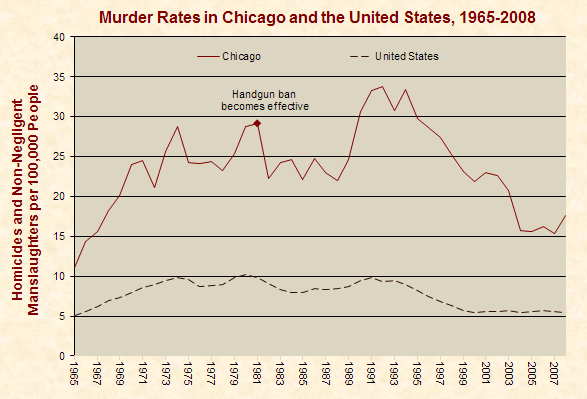
Not only that, but in 2012 the federal court also overturned the entire state of Illinois's concealed weapons ban!
Now this graph stops at 2007, though you can easily look up the rest of the manslaughter rates/gun crime rates rising since 2010. Now tell me, why do people use Chicago as an example of gun control when Chicago has loose gun laws? Because none of them really know about the 2010 hangun ban oveturn and just like to find something and use it to support them when in reality it doesn't. Also, let's not forget Chicago is a city and that obtaining guns from city/state to city/state can be really easy. What would stop someone from Chicago to go to Milwaukee to obtain a gun, and then go back to Chicago? Nothing really.
That fact alone confuses me as to why people would use a city as an example for gun control, either for or against. If it were federal/national and it did/didn't work, then we could use the information and learn from it. It also wouldn't hurt to learn from other countries such as Great Britain, Japan, or Germany, where there are semi-strict gun laws, and barely any form of gun crime. We could take their examples, and apply it to our country, but even better. Unfortunately the cold war-type mindset of "different opinions = bad!" still rings strong in some minds, when it really shouldn't.
Wednesday, April 3, 2013
Democratic Underground: A site for whiny crybabies who think anything remotley Republican is "evil"
I wouldn't exactly call myself a Liberal or a Conservative, though my views lean more liberal than any other sort of party. When I discovered Democratic Underground through searching up things (such as Ron Paul, as I can't stand him) and the more I browsed through their forums, the more I felt like joining as it felt like being surrounded by a group of people who all had similar ideals to mine. I was wrong....
So a few days ago, I decided to make an account and started posting on a few forums. At first everything seemed fine, except when I posted on this forum:
http://www.democraticunderground.com/10022600872
Now my first post is up and visable, though the rest of mine aren't. This one little post started a pathetic war between me and a group of posters who bitched at me because of what I said about the cartoon. Now instead of being rational and maybe explaining what I said that was so wrong (tbh it's not that I disagreed that the cartoon didn't list important points, the cartoon itself was just full of arrogance and complaining about something without doing anything about it that it angered me), instead I get yelled at by people who midsunderstand my points, call me a libertarian/conservative (odd.....), and just needless bitching on myself as if they didn't just meet me (I posted that at least an hour after I created my account)
So much for open conversations, the rest of it was just exaggerationg facts to fit themselves, and me getting 2 messages of mine hidden (which apparently means I can't post on that one thread). One message was me putting the words "butthurt" into my comment which apparently means it's rude and that DU are sensative, while the other comment was me making "conservative statements", which I didn't understand until I read their Terms of Service. I thought the TOS would be simple forum rules, such as no trolling or spamming and all that... I was wrong
http://www.democraticunderground.com/?com=termsofservice
Most of the TOS is that common stuff, except a few rules:
So anything that remotley resembles a "wingnut" ideal is bad? So much for open-minded people (especially when if you do a quick search on their site, they bash people for being too close-minded. mmmh.....). That rule just sealed the deal that I was on a site for paranoid leftists who only want to bitch at things and never do anything to change it. I bet if you gave even the slightest bit of commemoration to Ronald Reagan or George Bush, you'd be labeled a Nazi and banned.
Shortly after my hectic debate with those people, I was soon revoked/banned, which I'm glad because I'd rather not join a forum for a bunch of idiots like those people. Not to say that I hate either party, I just hate those who take it to the heart when somebody has a different opinion than yours.
So a few days ago, I decided to make an account and started posting on a few forums. At first everything seemed fine, except when I posted on this forum:
http://www.democraticunderground.com/10022600872
Now my first post is up and visable, though the rest of mine aren't. This one little post started a pathetic war between me and a group of posters who bitched at me because of what I said about the cartoon. Now instead of being rational and maybe explaining what I said that was so wrong (tbh it's not that I disagreed that the cartoon didn't list important points, the cartoon itself was just full of arrogance and complaining about something without doing anything about it that it angered me), instead I get yelled at by people who midsunderstand my points, call me a libertarian/conservative (odd.....), and just needless bitching on myself as if they didn't just meet me (I posted that at least an hour after I created my account)
So much for open conversations, the rest of it was just exaggerationg facts to fit themselves, and me getting 2 messages of mine hidden (which apparently means I can't post on that one thread). One message was me putting the words "butthurt" into my comment which apparently means it's rude and that DU are sensative, while the other comment was me making "conservative statements", which I didn't understand until I read their Terms of Service. I thought the TOS would be simple forum rules, such as no trolling or spamming and all that... I was wrong
http://www.democraticunderground.com/?com=termsofservice
Most of the TOS is that common stuff, except a few rules:
Don't be a wingnut (right-wing or extreme-fringe).
Democratic Underground is an online community for politically liberal people who understand the importance of working within the system to elect more Democrats and fewer Republicans to all levels of political office. Teabaggers, Neo-cons, Dittoheads, Paulites, Freepers, Birthers, and right-wingers in general are not welcome here. Neither are certain extreme-fringe left-wingers, including advocates of violent political/social change, hard-line communists, terrorist-apologists, America-haters, kooks, crackpots, LaRouchies, and the likeSo anything that remotley resembles a "wingnut" ideal is bad? So much for open-minded people (especially when if you do a quick search on their site, they bash people for being too close-minded. mmmh.....). That rule just sealed the deal that I was on a site for paranoid leftists who only want to bitch at things and never do anything to change it. I bet if you gave even the slightest bit of commemoration to Ronald Reagan or George Bush, you'd be labeled a Nazi and banned.
Shortly after my hectic debate with those people, I was soon revoked/banned, which I'm glad because I'd rather not join a forum for a bunch of idiots like those people. Not to say that I hate either party, I just hate those who take it to the heart when somebody has a different opinion than yours.
Subscribe to:
Posts (Atom)